
Why Is My Baby Taking Short Naps? When It’s Normal—and When to Troubleshoot
If your baby naps for exactly 32 minutes, pops their eyes open, and suddenly your entire afternoon is shot, it is very tempting to immediately start changing things.
Longer wake window? Earlier nap? Darker room? More rocking? Less rocking?
But your baby's short nap might not actually be the problem.
As a Certified Pediatric Sleep Consultant, the first thing I want to know when a parent tells me their baby is taking short naps is how old their baby is. Then I want to know how long they were awake before the nap, how sleep onset happened, how they woke up, what the sleep environment looked like, and whether this was one random short nap or a consistent pattern.
Because those details matter.
A 32-minute nap from a 10-week-old and a 32-minute nap that is happening over and over again with an 8-month-old can tell me two completely different stories.
When Do Babies Start Taking Longer Naps?
Newborn naps are honestly kind of a free-for-all.
Some newborns will take a two-hour nap like it is their full-time job. Others will sleep for 28 minutes, wake up, eat, stare at the ceiling fan for a while, and then be ready to sleep again.
That’s because newborn sleep is still incredibly immature. Their sleep cycles are still developing, their circadian rhythm is still organizing, and they are not necessarily going to move smoothly from one sleep cycle into the next every single time.
I generally start expecting naps to become more reliably consolidated around 6 months old. That doesn’t mean every baby suddenly wakes up on their six-month birthday taking beautiful 90-minute naps, though. Some babies connect sleep cycles earlier. Some need more time. But before about 6 months, short naps can still be very developmentally appropriate, even when you are doing everything “right.”
So if your 10-week-old is taking 30-minute naps, my first thought is not automatically, Something is wrong.
If your 8-month-old has been taking 30-minute naps consistently for weeks? Now we can investigate a little further and make meaningful changes to help them take longer naps.
1. Start With Wake Windows
This is probably the biggest contributor I see when an older baby is consistently taking short naps. And this is where sleep pressure matters.

Okay but… what even is sleep pressure?
Sleep pressure is basically just a fancy sleep-consultant term for tiredness. Too little sleep pressure creates an undertired baby, while too much sleep pressure can create an overtired baby. The goal is to find that little sweet spot in the middle where your baby is tired enough to fall asleep and stay asleep, but not so exhausted that their body is fighting sleep.
Honestly, Huckleberry calling this the “SweetSpot” is pretty accurate, because that is exactly what we are trying to find.
If your baby has too little sleep pressure, their wake window may simply be too short. They might still fall asleep because they are tired enough to doze off, but not tired enough to stay asleep very long. These are often the babies who wake up after 30 or 40 minutes looking completely refreshed, happy, alert, and absolutely uninterested in going back to sleep no matter what you try.
If your baby has too much sleep pressure, you are looking at the opposite problem. Overtired babies may fall asleep very quickly because they are exhausted, but then wake after that first sleep cycle crying, fussy, and very obviously still tired. They often need much more support to regulate and settle back to sleep, especially during the day when sleep pressure is naturally lighter than it is overnight.
This is why wake windows matter so much during the first year.
Not sure what your baby’s wake window should be?
Download my free Wake Window Roadmap™. It breaks down wake windows, number of naps, total daytime sleep, and total 24-hour sleep needs by age so you have an actual place to start instead of trying to piece together six different wake-window charts from Google.
2. Your Baby May Be Ready to Drop a Nap
Sometimes short naps are not really a nap-length problem. They are a schedule problem.
As babies get older, they need more awake time between sleep periods. Eventually, there simply is not enough room in the day to keep fitting the same number of naps, and that is when nap transitions start happening.
Very generally, I expect the 4-to-3 nap transition around 4 to 5 months, the 3-to-2 nap transition somewhere around 6 to 9 months, the 2-to-1 nap transition around 12 to 15 months or a little later, and the 1-to-0 nap transition usually somewhere around age 3. There is always some variation, especially with that final nap transition, so I care much more about what the child is showing me than whether they have technically reached a specific month.
A baby who is ready to move from three naps to two may suddenly start fighting one of their naps, taking longer to fall asleep, refusing the final nap, pushing bedtime too late, or taking shorter naps because they simply need more awake time between sleep periods.
This is why nap transitions and wake windows go hand in hand. If your baby needs more awake time, but you are still trying to squeeze three naps into a day that really only fits two, something usually starts falling apart, and a lot of the time that “something” is nap length.
3. Check the Nap Environment
Newborns are funny because they can sleep through basically anything. The lights are on, the dog is barking, someone is unloading the dishwasher, there is a full-blown conversation happening five feet away, and your newborn is completely unconscious.
Babies are not born with a fully developed circadian rhythm. They really have no clue when it is daytime or nighttime yet, and those rhythms develop gradually over the first few months. During that newborn stage, I generally recommend letting daytime naps happen in a safe sleep space with natural daylight and normal household sounds around them. There is no need to create cave-like conditions for every nap during those first 3-ish months. We want daytime to feel like daytime and nighttime to feel like nighttime while their circadian rhythm is developing.
Then somewhere around 3.5 to 4 months, your little sleepy blob suddenly becomes a tiny, extremely nosy person.
Everything is interesting. The ceiling fan is interesting. The curtains are interesting. A shadow on the wall is interesting. A piece of lint you cannot even see is apparently fascinating.
Life is very exciting when you’ve only been on Earth for four months.
This is when many babies start napping better in those darker, more boring sleep environments. Not because babies magically require a cave once they hit four months, but because they now have a whole lot more FOMO. If they come into lighter sleep between sleep cycles and their entire room is bright and stimulating, there are a lot more reasons to fully wake up and start exploring instead of transitioning back into sleep.
A dark, boring room simply gives them fewer reasons to decide the nap is over.
4. How Is Your Baby Falling Asleep?
This one is HUGE!
How sleep starts can directly affect what happens when your baby transitions between sleep cycles. Infant sleep cycles are roughly 45–50 minutes long on average, which is why you may notice your baby waking at almost the exact same point during every nap. That transition into lighter sleep is where some babies briefly stir and move into another sleep cycle, while others wake fully.
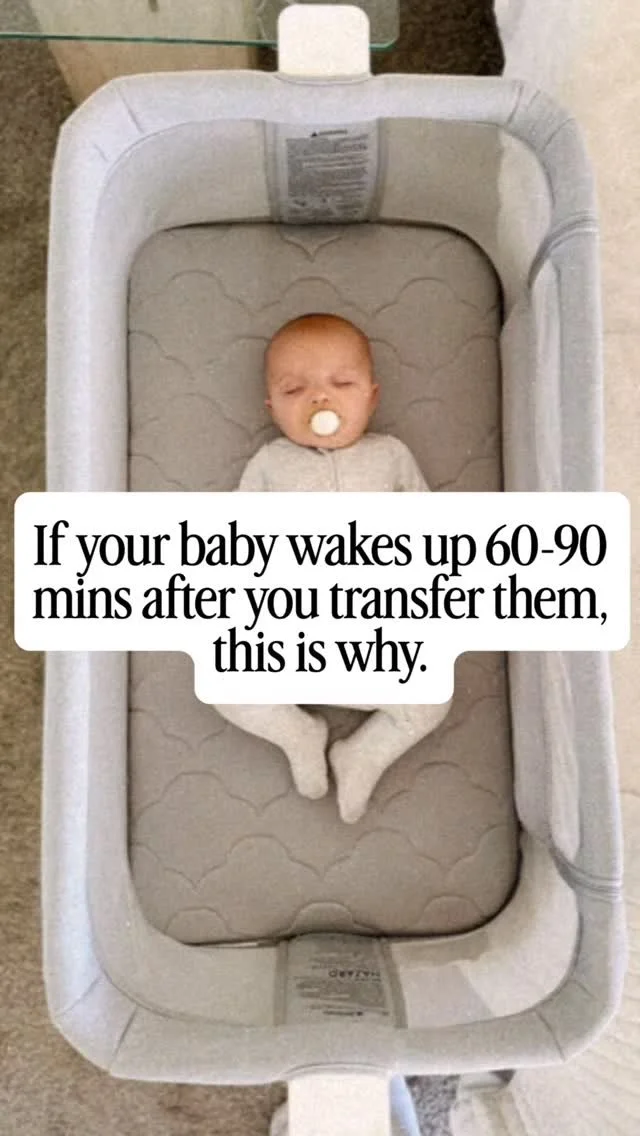
If your baby falls completely asleep while feeding, rocking, bouncing, being held, or with some other form of support, that support becomes part of how falling asleep happens for them. If they are then transferred to a crib or bassinet, they may reach the end of that sleep cycle, become more aware of their surroundings, and realize that the conditions they fell asleep with are no longer there.
For babies who do not yet have the skills to fall back asleep independently, that change can be enough to fully wake them. They may cry out and need the same support again—rocking, feeding, bouncing, holding, whatever helped them fall asleep in the first place—to get back into sleep.
And if you are completely okay helping your baby back to sleep every time, this is not necessarily a problem.
But if you are tired of being nap trapped, tired of rescuing every nap, or stuck in a chronic cycle of 30- to 45-minute naps where your baby needs you to bridge every sleep cycle, helping your baby build independent sleep skills can be a really effective way to break that pattern.
That is exactly the kind of thing I help families work through. If your baby’s schedule looks right, the sleep environment looks right, but naps are still falling apart because they need help getting back to sleep every single time, schedule a complementary sleep consult with me below and we can talk through what is happening and what kind of support may make sense for your family.
5. Sometimes Your Baby Just Feels Yucky
There is a LOT of conflicting information online about whether teething or sickness actually affect baby sleep. As a mom to a toddler who has been sleeping independently since she was 5 months old, and as a sleep consultant who has seen this with families over and over again, I can tell you that teething and sickness can absolutely mess with naps and overnight sleep.
If your baby has a stuffy nose, an upper respiratory infection, an ear infection, or they are cutting a tooth that is really bothering them, it makes complete sense that naps might suddenly be shorter because they are uncomfortable.
Even babies and toddlers who normally sleep independently can suddenly wake more often and need more help during those periods. Give it to them. Rock them, hold them, comfort them, and help them get the sleep they need.
This is where I differ from a lot of other sleep consultants. While I think independent sleep is important, I think it is more important that we show up to comfort and soothe our child when they truly need us. You can always get back to independent sleep once they are feeling better.
Need Help Figuring Out Your Baby’s Naps?
If you are not sure whether your baby’s wake windows or nap schedule are actually appropriate for their age, start with my free Wake Window Roadmap™. It breaks down wake windows, number of naps, daytime sleep, and total 24-hour sleep needs by age so you have a clear place to start.
Still not sure why naps aren’t clicking? Schedule a complimentary sleep consult with me below. We’ll talk through what’s going on and I’ll help you figure out what the best next step to get your baby sleeping should be.
And if you are not ready to book a call but want a place to ask questions and get support, join my free Nite Nite Baby sleep training Facebook group. It is a peer-support space where you can ask questions about naps, schedules, sleep training, bedtime, night wakes, and all the random sleep things that come up along the way.
Binge my content below for all things baby, toddler & big kid sleep, and hit the follow button to stick around for more!